“Do Not Push!”: the disco washroom
Under A22 Technology Solutions. The work that became A22's first engagements.
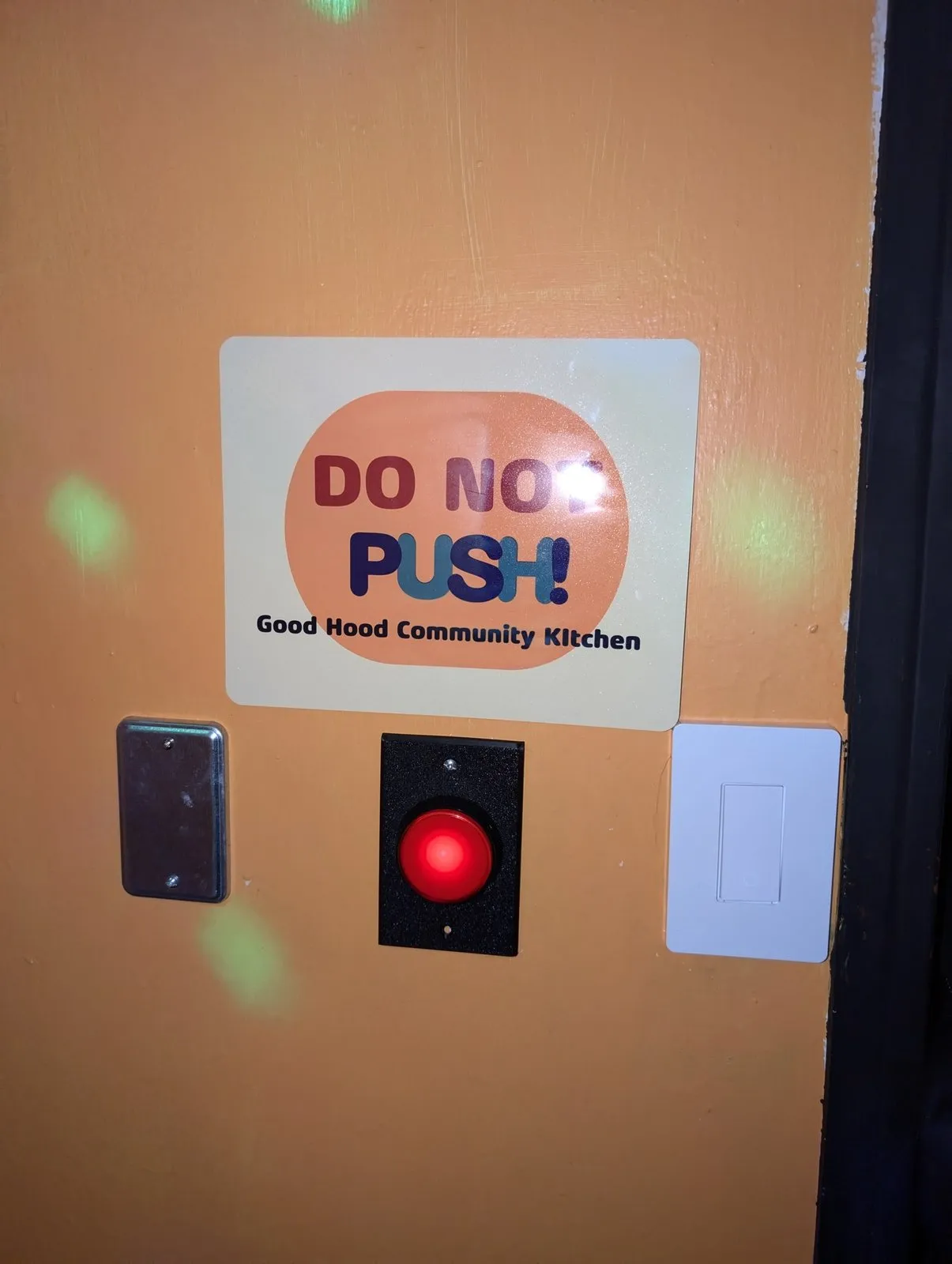
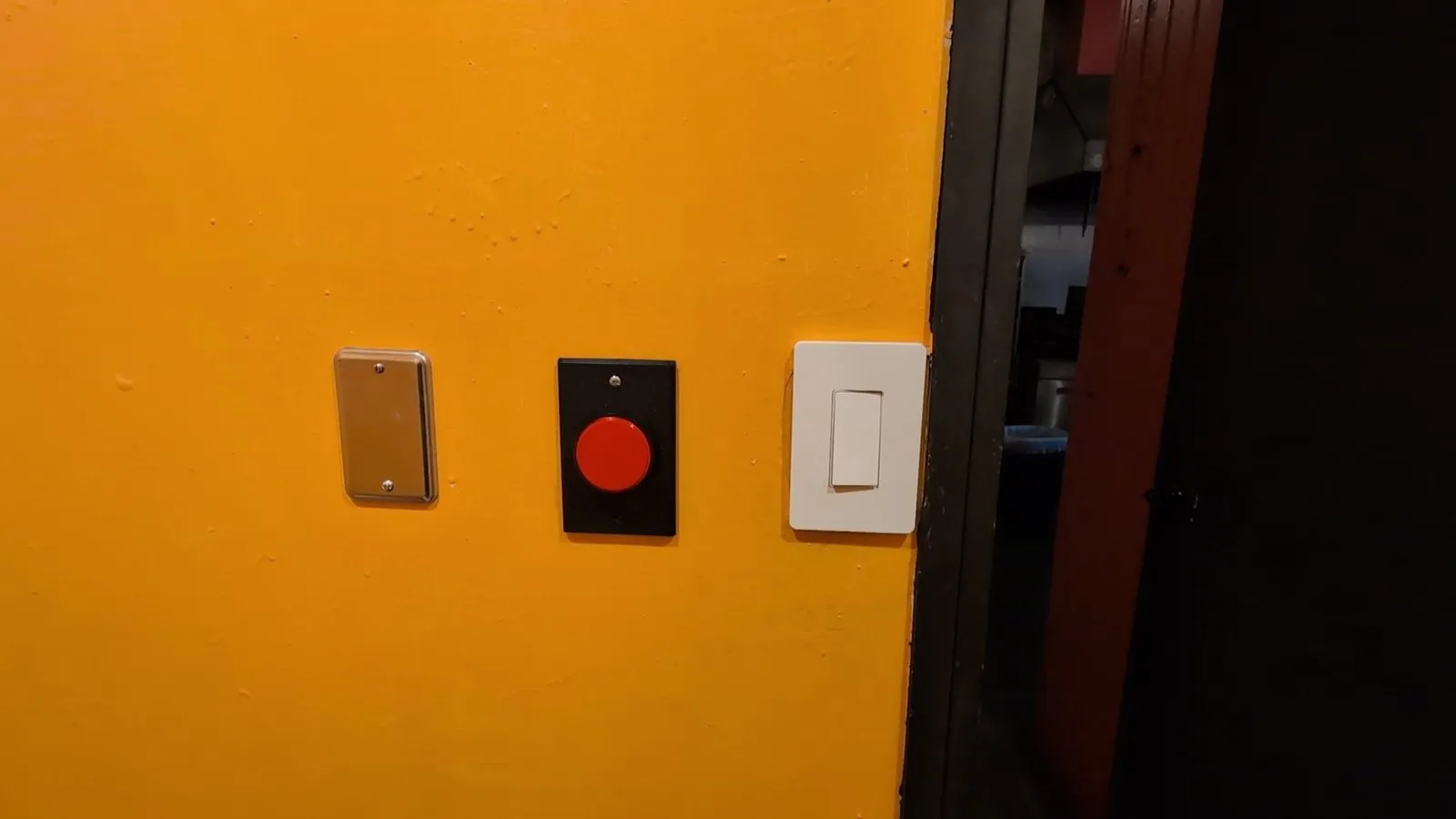
In a community kitchen’s washroom, a red arcade button sits under a sign that reads “DO NOT PUSH!” Press it and the lights go out, a disco light and a song take over for about half a minute, and then the room puts itself back.
The problem
Not every problem is a cost problem, and I won’t pretend this one was. Good Hood Community Kitchen wanted its space to be fun, enjoyable and unique, a place people remember. It was paid work.
They had wanted this for a while. The kitchen had been looking for someone to build it for about two years, and had been ready to fly specialists in from Europe to get it done.
The sign is the joke: a button that dares you to press it.
The real engineering problem sits behind the joke. A button in a shared washroom is pressed by whoever walks in, as often as they like, as fast as they like. It has to work every time and put the room back to normal every time, with nobody there to reset it.
What I built
| Part | What it is |
|---|---|
| The trigger | A red arcade pushbutton, beside the room’s light switch |
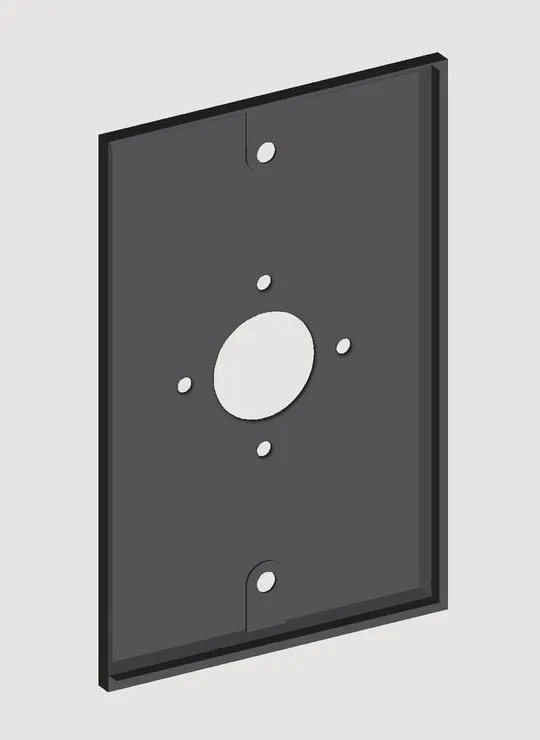
| The button plate | A custom wall plate, modelled in Fusion 360 and 3D-printed on a Flashforge Adventure 5M Pro, to hold the arcade button beside the room’s light switch |
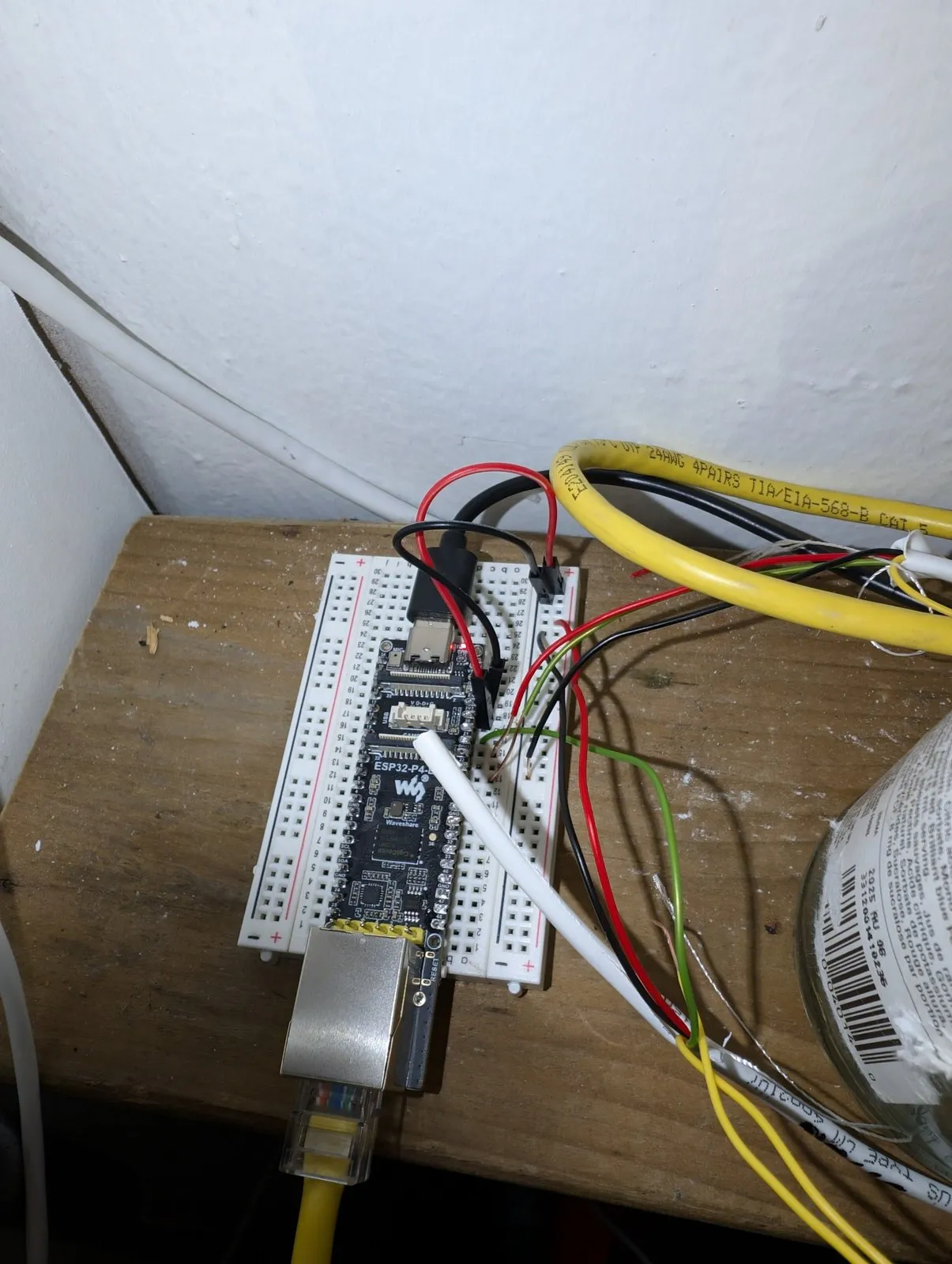
| The controller | A Waveshare ESP32-P4-ETH board on wired Ethernet, running ESPHome, mounted on a shelf |
| The disco light | An off-the-shelf disco light driven by an infrared transmitter on the controller, sending the light’s own remote-control codes (power, flash, modes, movement) |
| Room lights | A TP-Link HS200 smart wall switch, switched by Home Assistant. It replaced a Sonoff flat panel (see “The build”) |
| The music | Home Assistant plays one of three short songs at random through a music player daemon on an Orange Pi 3B, over an aux cable to speakers |
| Orchestration | Home Assistant automations, plus a volume slider exposed by the controller |
The reader’s next question: “Why infrared?” The disco light already had a remote. I bought an IR transmitter and had the controller send the remote’s codes, so the light never had to be taken apart or rewired. It also means the light can be replaced with another off-the-shelf unit.
What a press does.
- The room light switches off.
- The controller sends the disco light’s power code.
- A random song, 20 to 29 seconds long, starts playing.
- When the song ends, the automation turns itself off, and the room light comes back on.
- Pressing the button again during the show stops it early and brings the room back the same way.
The reader’s next question: “What if someone mashes it?” The automations run in restart mode on purpose: a fast second press cancels the step in progress rather than queueing behind it. Without that, the infrared command could be dropped and the light, the button’s glow and the music would fall out of step.
The build
- October 2025: the work begins.
- 15 February 2026: bench prototype. An ESP32 on a breadboard, the arcade button, and the disco light stepping through its modes from a phone.
- 16–17 February: the room lights. A Sonoff smart switch wired in and driven from Home Assistant. It was later replaced by a TP-Link HS200 (decision two).
- 6 March: installed on site. First full run in the washroom.
- 9 March: a network cable run and terminated for the controller.
- 16–20 March: final runs, then the finished wall with the sign.
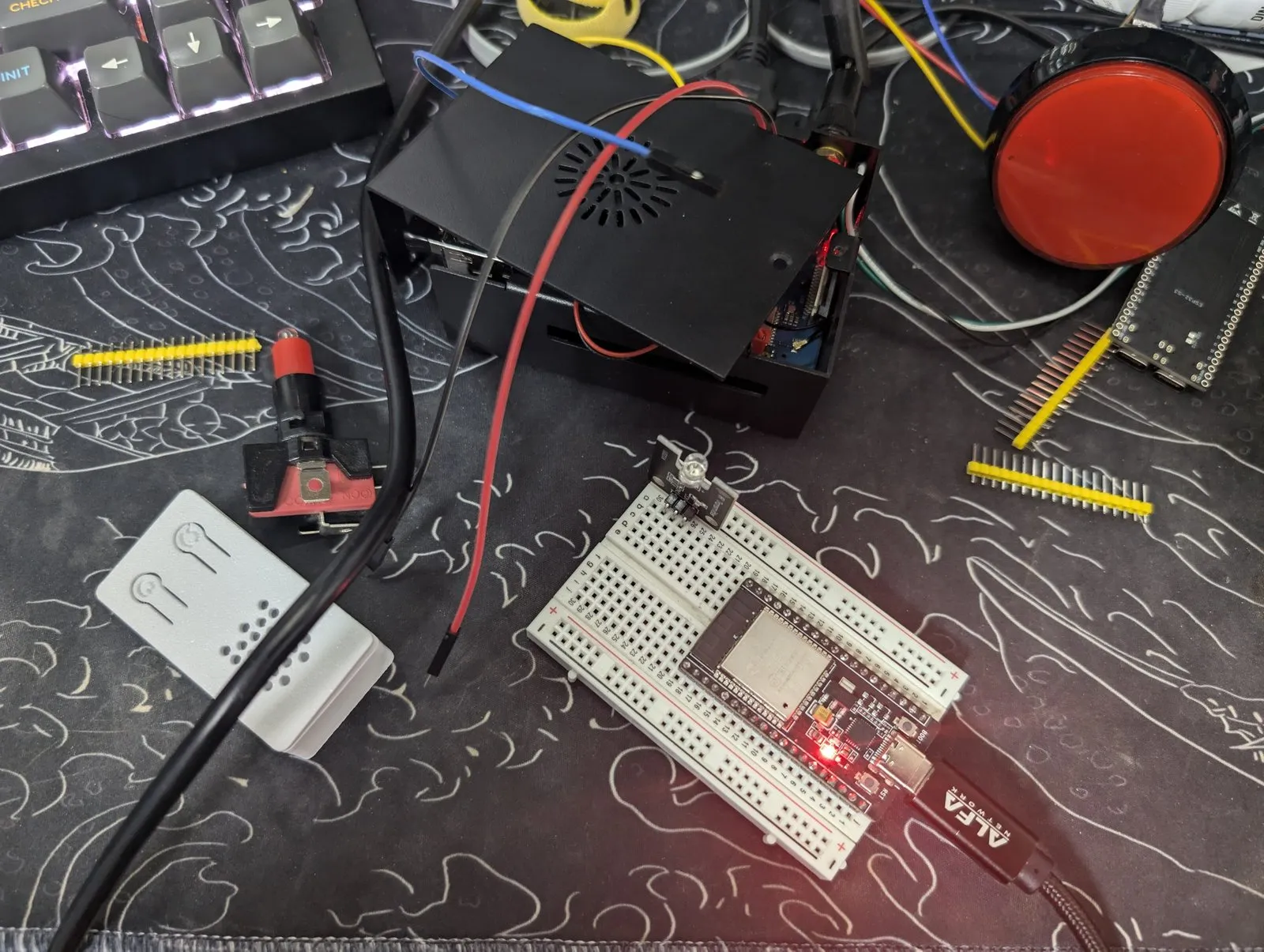
Decision one: from Wi-Fi to a wired board. The prototype ran on a Wi-Fi ESP32. The installed version runs on a board with wired Ethernet, and a network cable was run to it. I made that change for reliability. A button that works most of the time is worse than no button, because everyone who presses it on a bad day sees it fail.
Decision two: a switch people understand. The first room switch was a Sonoff flat panel. It was swapped for a TP-Link HS200, because it was less confusing than a flat panel. The people who use this switch are whoever walks into a washroom; it has to read as a light switch at a glance. The button got the same care. No stock wall plate fits a full-size arcade button, so I modelled one in Fusion 360, sized like a standard wall plate (about 80 × 124 mm) so it sits beside the switch as if it belonged there, and printed it myself on a Flashforge Adventure 5M Pro.
Decision three: the button that pressed itself. After installation, the show sometimes started with nobody touching the button, from 30 March to 8 May 2026. The cause was the infrared transmitter itself: its 38 kHz signal was coupling into the button’s wire, which the controller read as a press. The fix was a small filter on the button line, a 4.7 kΩ pull-up resistor and a 100 nF capacitor.
The reader’s next question: “How did you find it?” The log names the cause and the fix; it does not walk through the hunt, and I won’t reconstruct one from memory here.
The result
- Installed, paid for, and working. Two dated on-site clips, from 6 March and 16 March 2026, show a press setting off the full show.
- No phantom presses since 8 May 2026, the day the filter went in.
- A space the kitchen had wanted for about two years, built locally, without flying anyone in.
Running time and the number of presses are not recorded, and none is claimed.
Evidence
The code is public: AlexTu2/ghck-disco-arcade
on GitHub, with the ESPHome firmware, the Home Assistant automations, the wiring with the
filter, the bill of materials and the build log.